Cedric Griffin Extension
The Vikings signed Cedric Griffin to an extension over the weekend, locking him up through the 2015 season for $25 million, $10 million of which is guaranteed. I think it's likely a good deal, so long as the Vikings realize that Griffin has yet to show he can be the #1 cornerback on a good defense.
First off, the money isn't a big deal because most of it is probably going to count against this year's cap, a necessity since the Purple seem to be near the salary floor. Secondly, it assures that the Vikings have at least one of their two starting cornerbacks under contract after this year, which they couldn't have said before. And that means that when they aren't forced to throw money at cornerbacks next year (whether that be Winfield and Griffin or free agents) because they already have a solid one. Now they can choose to cut bait on Winfield if his production drops in the final year of his contract (like they did with Sharper) or they can re-sign him if they feel he's worth bringing back, but they don't have to make the decision while trying to retain or replace their other starting cornerback at the same time.
The only thing that worries me about this contract extension is that the Vikings might decide that Griffin is good enough to be their best cornerback. While Griffin played well at times last year, he wasn't consistently good enough last year to be counted on as the top corner on the roster (you might recall talk of benching him in favor of Charles Gordon before Gordon got hurt). He might take that next step this year, but he might not, which means the Purple have to continue to pursue corners in the draft and in free agency.
Glenn Holt
The Vikings continued to upgrade their special teams by signing Glenn Holt, the kick returner for the Cincinnati Bengals. Holt is a massive upgrade over Maurice Hicks (who isn't?). Unlike Hicks, who, in 185 kick returns prior to joining the Vikings, had returned exactly one kick for more than 60 yards (his career long was 64 yards) and only 8 for more than 40 yards, Holt has shown the ability to break a long one. He's returned one kick for a touchdown already, and has 8 of 122 returns for more than 40 yards and was tied for the 7th most kick returns for more than 40 yards last year.
Now, Holt's not exactly Devin Hester, but he's a solid returner with the ability to break one. He's also going to give the Vikings a better chance of starting with good field position. Last year, the Vikings returners (excluding Jimmy Kleinsasser and Naufahu Tahi) only returned 48% of kick offs (27 of 56) 20 yards or more. Of the 122 kicks that Holt has returned in his career, he's taken 78 of them 20 yards or more (64%). And last year, he returned 61% of the kicks he fielded 20 yards or more.
So while the Holt signing may not be all that sexy (like a Terry Holt signing would be), it definitely upgrades the Vikings' roster and provides a quality veteran kick returner to compete for the position with Darius Reynaud and Aundrae Allison. And upgrading the kick return game will help the Vikings' run first offense score more points (and help the defense prevent points) by giving the Vikings' good starting field position after kickoffs, something they couldn't count on last year.
Showing posts with label Solving Our Problems. Show all posts
Showing posts with label Solving Our Problems. Show all posts
Tuesday, March 24, 2009


Friday, March 13, 2009
Solving Our Problems: Leonard Weaver
One of the issues that the Vikings had last year that isn't discussed all that often was their failure to sign a replacement for Tony Richardson at Fullback. It's not a glamorous position, or one that the fans really notice (me included). That being said, it was clear that Thomas Tapeh wasn't good enough (he was cut, if you recall) and Naufahu Tahi was pretty awful (as I said earlier, he's a horrible blocker who gained 37 receiving yards on 21 targets with a -77.4%DVOA and accumulated -77 DYAR).
And it looks like Vikings aren't going to settle on just bringing Tahi back (since he's, you know, bad) as they're interested in fullback Leonard Weaver of the Seahawks.
Weaver was an alternate for the Pro Bowl last year at 26, and he's a big dude, standing 6' tall and weighing 242lbs. In his four year career, he's rushed for 356 yards on 80 attempts, for an average of 4.5 yards per carry. 25 of those carries have gone for first downs, showing his ability to get the short yards (though he wasn't used much in the red zone, only scoring one touchdown in his career). According to Football Outsiders, he had -1 DYAR and a -9.0% DVOA on his 30 carries last year, and 40 DYAR and 16.0% DVOA on 33 carries the year before (not surprising to see fluctuations like that in such a small sample size).
He's a very good pass catcher as well, with 60 catches for 547 yards (9.7 YPC) and two touchdowns. Last year he finished with 45 DYAR and a 15.6% DVOA while catching 63% of the 32 passes thrown his way. The season before his 89 DYAR was 11th among running backs and his 17.3% DVOA was 14th. He also brought in 75% of the 52 passes thrown his way.
He has the statistics of a stud fullback, but in the Vikings offense, that's not enough. I asked the folks at Dave Krieg's Strike Beard for a scouting report and here's what they said:
That assessment seems to match what the Vikings are looking for (though the fact he's not a great lead blocker isn't a good thing--but that's what Jim Kleinsasser is for). He's a solid pass blocker (so Childress will allow him to play in passing downs) that's also a pass catching threat out of the backfield (and we all know how much Childress likes the swing pass--might as well have them go to a player that can gain some yards instead of to Tahi) and who can convert short yardage situations. So he'd be a big upgrade from Tahi. And while that's not necessarily saying too much (though Weaver sounds like a solid player), it's important to try and upgrade your entire roster when you have the chance. Weaver's an upgrade, which means if he's at all reasonable contract wise, he'd be a good acquisition.
And it looks like Vikings aren't going to settle on just bringing Tahi back (since he's, you know, bad) as they're interested in fullback Leonard Weaver of the Seahawks.
Weaver was an alternate for the Pro Bowl last year at 26, and he's a big dude, standing 6' tall and weighing 242lbs. In his four year career, he's rushed for 356 yards on 80 attempts, for an average of 4.5 yards per carry. 25 of those carries have gone for first downs, showing his ability to get the short yards (though he wasn't used much in the red zone, only scoring one touchdown in his career). According to Football Outsiders, he had -1 DYAR and a -9.0% DVOA on his 30 carries last year, and 40 DYAR and 16.0% DVOA on 33 carries the year before (not surprising to see fluctuations like that in such a small sample size).
He's a very good pass catcher as well, with 60 catches for 547 yards (9.7 YPC) and two touchdowns. Last year he finished with 45 DYAR and a 15.6% DVOA while catching 63% of the 32 passes thrown his way. The season before his 89 DYAR was 11th among running backs and his 17.3% DVOA was 14th. He also brought in 75% of the 52 passes thrown his way.
He has the statistics of a stud fullback, but in the Vikings offense, that's not enough. I asked the folks at Dave Krieg's Strike Beard for a scouting report and here's what they said:
"Leonard Weaver has been a fan favorite in Seattle since he arrived as an undrafted free agent in 2005 (at least among us football nerds). After
having injury problems in 2006 and nearly getting cut after a
disappointing 2007 preseason, 2008 was his breakout year (he was a Pro
Bowl Alternate). Here's the pros and cons on Weaver:
PROS:
-Excellent receiver out of the backfield
-Exceptional pass blocker
-Effective rusher on the few carries he gets
CONS (from Seattle's perspective):
-Not an effective lead blocker in the running game
-The Seahawks drafted Owen Schmitt last year, who is more of a traditional
"bruiser" type of fullback
-Seattle has a new offensive coordinator in Greg Knapp, whose system
wouldn't seem to have a place for Weaver.
The vast majority of Seahawks fans want him to remain with the team, but
it's clear the front office only wants him back at a certain price and not
a nickel more.
My take? Leonard Weaver is a unique weapon in today's NFL, and would be a
great pick-up for the Vikings if they utilize him correctly; Just don't
expect him to be a battering ram for Purple Jesus. That just isn't his
skill set."
That assessment seems to match what the Vikings are looking for (though the fact he's not a great lead blocker isn't a good thing--but that's what Jim Kleinsasser is for). He's a solid pass blocker (so Childress will allow him to play in passing downs) that's also a pass catching threat out of the backfield (and we all know how much Childress likes the swing pass--might as well have them go to a player that can gain some yards instead of to Tahi) and who can convert short yardage situations. So he'd be a big upgrade from Tahi. And while that's not necessarily saying too much (though Weaver sounds like a solid player), it's important to try and upgrade your entire roster when you have the chance. Weaver's an upgrade, which means if he's at all reasonable contract wise, he'd be a good acquisition.
Thursday, March 12, 2009
Solving our Problems: Kevin Shaffer
After Jordan Gross and Vernon Carey re-signed with their teams, it seemed like the Vikings were going to have to address the right side of their line through the draft. The tackles available in free agency were either old, had injury issues or both. Any long term answer was going to have to come from the draft. That might not be true anymore, as the Cleveland Browns just released their starting right tackle, Kevin Shaffer. Of course, I might be wasting my time on this post, just like I wasted my time on a post about Vernon Carey, as Shaffer is considering re-signing with the Browns for a smaller contract than before.
If he does decide to enter free agency, however, the Vikings should jump on him. First off, he has a ridiculous beard. Look at it and tell me you don't want him in Purple:

Secondly, he's relatively young, just turning 29 last week. And he can both run and pass block (two skills Ryan Cook doesn't have). He moved from left to right tackle to accommodate #3 pick Joe Thomas in 2007 showed that he was much more effective on the right side. And since then, when the Browns have run to the right, they've been successful. In 2007, they averaged 4.73 Adjusted Line Yards running over the right tackle and 5.03 ALY running to the right end, the 3rd and 2nd most yards in the NFL respectively. In 2008, they averaged 4.64 ALY and 4.59 ALY, the 7th and 6th best totals in the league. In contrast, the Vikings were 21st in ALY to the right tackle and 28th to the right end in 2007 and 28th and 8th to the right end (remember, the tight end is equally important in plays to right end) in 2008.
While its hard to isolate Shaffer's pass blocking from the rest of his linemates, odds are he was a very good pass blocker, because the Browns just did not give up sacks the past two years. In 2007, they were 5th in Adjusted Sack Rate, only allowing 19 sacks all year, and in 2008 they were 8th, allowing only 25 sacks. The Vikings, in contrast were 28th in ASR the past two years, allowing 38 and 43 sacks in 2007 and 2008 respectively.
Kevin Shaffer, like Vernon Carey, would be a very good answer to the Vikings' troubles at right tackle. He'd also free up Ryan Cook to challenge John Sullivan for the starting job at center, give Tarvaris (or Sage) some more time to throw the ball and allow the Vikings to successfully run the ball to the right. If he doesn't re-sign with the Browns, the Vikings need to do everything they can to bring Shaffer to Winter Park and get him signed.
[All statistics courtesy of Football Outsiders]
If he does decide to enter free agency, however, the Vikings should jump on him. First off, he has a ridiculous beard. Look at it and tell me you don't want him in Purple:

Secondly, he's relatively young, just turning 29 last week. And he can both run and pass block (two skills Ryan Cook doesn't have). He moved from left to right tackle to accommodate #3 pick Joe Thomas in 2007 showed that he was much more effective on the right side. And since then, when the Browns have run to the right, they've been successful. In 2007, they averaged 4.73 Adjusted Line Yards running over the right tackle and 5.03 ALY running to the right end, the 3rd and 2nd most yards in the NFL respectively. In 2008, they averaged 4.64 ALY and 4.59 ALY, the 7th and 6th best totals in the league. In contrast, the Vikings were 21st in ALY to the right tackle and 28th to the right end in 2007 and 28th and 8th to the right end (remember, the tight end is equally important in plays to right end) in 2008.
While its hard to isolate Shaffer's pass blocking from the rest of his linemates, odds are he was a very good pass blocker, because the Browns just did not give up sacks the past two years. In 2007, they were 5th in Adjusted Sack Rate, only allowing 19 sacks all year, and in 2008 they were 8th, allowing only 25 sacks. The Vikings, in contrast were 28th in ASR the past two years, allowing 38 and 43 sacks in 2007 and 2008 respectively.
Kevin Shaffer, like Vernon Carey, would be a very good answer to the Vikings' troubles at right tackle. He'd also free up Ryan Cook to challenge John Sullivan for the starting job at center, give Tarvaris (or Sage) some more time to throw the ball and allow the Vikings to successfully run the ball to the right. If he doesn't re-sign with the Browns, the Vikings need to do everything they can to bring Shaffer to Winter Park and get him signed.
[All statistics courtesy of Football Outsiders]
Friday, February 27, 2009
Killing Time: Rumor Craziness & Housh
So far, the Vikings have done, well, nothing, aside from formalize the trade for Sage Rosenfels. I haven't seen or heard anything about which players are visiting Winter Park, or, really, anything new about any of their free agent targets. Negotiations continue with Matt Birk and Jim Kleinsasser, and the Purple have made offers to restricted free agents Fred Evans (a solid back up for the Williams Wall) and Naufahu Tahi (a horrible blocker who gained 37 receiving yards on 21 targets with a -77.4%DVOA and accumulated -77 DYAR). So really, no big changes except for a fun little rumor started by T.J. Houshmandzadeh who appears to enjoy flirting with every franchise's fanbase. As he said yesterday,
If the Vikings can sign Housh that gives them a reasonable protection against his age 34, 35 and 36 seasons (the upcoming season is his age 32 season), he should definitely be brought in (I'm fine with them paying him for 4 or 5 years for 2 great and one good season, but not with them paying him for 6 or 7 seasons). He's averaged 1012 receiving yards a year over the last five years, and 89 catches. Last year, despite spending 13 games catching passes from Ryan Fitzpatrick, he still caught 92 passes for 904 yards. While he's not a deep threat (he has only 6 catches for over forty yards and 67 catches over 20 yards the last five years), he is an amazing possession receiver--he's not Randy Moss, he's Chris Carter. His worst catch percentage over the last five years is 66% and he's a first down machine, averaging 56 first down catches a year over the past five years and finishing 16th, 1st, 7th and 16th in first down catches in the last four years. He'd be the perfect fit for a West Coast offense, and the perfect complement for Bernard Berrian.
The only question mark is whether he can be signed without a Haynseworthian contract that guarantees it will ruin the Vikings' cap situation as Housh ages. If he can't, he's probably not worth it. If he can be signed for a reasonable (within the context of #1 receiver contracts), then the Vikings should do everything they can to sign him. At the very least, the Purple need to find out the answer.
“I’m looking at teams I think have good coaches and good offensive lines and good running games. I have no idea if those teams are interested in me. If I can play with Adrian Peterson, can you imagine what I would do getting one-on-one coverage with Adrian Peterson? I am going to win 98.6 percent of the time with one-on-one coverage with him in the backfield.”He's also contacted a radio station in Philly and is generally having a good time with being wanted (though I have no idea how he was able to know how often he could beat one-on-one coverage within a tenth of a percent). Would Housh (you type his name out more than once) be a good fit for the Vikings? The answer--it depends on the price.
If the Vikings can sign Housh that gives them a reasonable protection against his age 34, 35 and 36 seasons (the upcoming season is his age 32 season), he should definitely be brought in (I'm fine with them paying him for 4 or 5 years for 2 great and one good season, but not with them paying him for 6 or 7 seasons). He's averaged 1012 receiving yards a year over the last five years, and 89 catches. Last year, despite spending 13 games catching passes from Ryan Fitzpatrick, he still caught 92 passes for 904 yards. While he's not a deep threat (he has only 6 catches for over forty yards and 67 catches over 20 yards the last five years), he is an amazing possession receiver--he's not Randy Moss, he's Chris Carter. His worst catch percentage over the last five years is 66% and he's a first down machine, averaging 56 first down catches a year over the past five years and finishing 16th, 1st, 7th and 16th in first down catches in the last four years. He'd be the perfect fit for a West Coast offense, and the perfect complement for Bernard Berrian.
The only question mark is whether he can be signed without a Haynseworthian contract that guarantees it will ruin the Vikings' cap situation as Housh ages. If he can't, he's probably not worth it. If he can be signed for a reasonable (within the context of #1 receiver contracts), then the Vikings should do everything they can to sign him. At the very least, the Purple need to find out the answer.
Friday, April 18, 2008
Solving Our Problems: Jared Allen
In case you somehow managed to miss the news, the Chiefs are shopping Jared Allen. That's right, Jared "lead the NFL in sacks despite missing two games" Allen is available for the right price, and the Vikings seem to have the best chance to acquire him.
Now, before we go any further, let's all take a deep breath, center our selves, and think about this analytically. Now, obviously, adding an elite pass rusher is the Vikings' main goal at this point. So, is Allen an elite pass rusher? Let's go to the stats and find out. Allen has 43 sacks in 61 career games, including 15.5 last season, where he missed the first two games due to suspension (don't worry, I'm going to get to that later). That means he has a sack rate of 11.28 sacks per 16 games. His worst year, 2006, he had 7.5 sacks, a number that would have lead the Vikings last year. And Kansas City had the third highest adjusted sack rate last year, bested only by the Patriots and the Giants. The Vikings were 28th. Allen is also good against the run, averaging over 56 tackles a year, a number dragged down by his rookie total of 30 tackles, and one which still would have been the 8th best on the Purple. And while he may still be the focus of opposing blocking schemes, he'll also be paired with the Williams and young pass rushers Ray Edwards and Brian Robison, which means that offenses will get to decide which player sacks their quarterback, but they won't be able to stop the Vikings from getting to him.
Now that we've come to the conclusion that Jared Allen is, in fact, an elite pass rusher (yeah, I know, a tough decision), it's time to consider the cost of acquiring him. The Chiefs have placed their franchise tag on him, which means that, technically, the Vikings could sign him right now. In order to do so, however, they'd have to give up two first round picks, one from this year, and one from next year. Obviously, they aren't going to do that, which means that, in order to trade him, the Chiefs have to accept something less than two first rounders. Rumor is that the Vikings are considering offering their first round pick this year and their second round pick next year for Allen. If the Chiefs prefer picks from this year's draft, that means that they'll likely have to accept a third round pick instead of a second rounder. The Vikings have the 17th, 47th, 73rd and 82nd picks. Ideally, they'd be able to convince the Chiefs to take the 82nd pick, along with the 17th, but, due to Tampa Bay's interest, they may have to deal the 73rd pick instead. Tampa has the 20th, 52nd and 80th pick, but only have 5 total draft picks this year, which makes each of their picks more valuable to them, and the Vikings can easily outbid them, as their picks are all higher than the Bucs'. Are a first and third round pick worth trading for an elite pass rusher? In a word--Yes. Odds are the Purple would be using one of those picks (if not both) on a defensive end anyway, and it's much better to get a proven commodity than have to take a chance on an unknown, when the proven commodity is very, very good.
Even if the Vikings reach a deal with the Chiefs, they're still going to have to reach a deal with Jared Allen. Rumor is that he wants Dwight Freeney money, which means a contract that is around six-years, for $72 million and $30 million guaranteed. To put that in context, the Purple were willing to offer an inferior end, Justin Smith, $20 million in guaranteed money and a six year contract for $45 million. Is Allen worth the cash? Well, yes, and no.
Yes, because Allen is only 26 years old, and likely to continue to be effective for the length of the contract and because that's the going rate for elite pass rushers. No, because Allen's already managed to pick up two DUI's in his four years, which is the reason why he served a two game suspension last year (which was originally four games). He says he has stopped drinking, which I'm willing to believe, but I'm not the one guaranteeing him $30 million dollars. I'm not sure how the Vikings can square trading for Allen with their "Culture of Accountability", nor am I sure if guaranteeing $30 million to a player who has already had his second strike is a good idea. The Vikings are supposedly considering trading Bryant McKinnie because of the fight he was allegedly involved in (remember, he hasn't been convicted of anything yet). And while it was McKinnie's fourth arrest, unlike Allen, he hasn't been found in violation of the NFL conduct policy for the second time yet. A third violation would likely mean a year long suspension, and the Vikings might not be able to recover the money they guaranteed Allen, and they certainly wouldn't be able to recover the draft picks they gave up to get him.
So, do I make this trade if I'm the Vikings? I think so. I have no problem with giving up a first and a third rounder this year (or a first rounder and a second rounder for next year) for a talent like Allen. Nor do I have a problem with paying a player like him the money he wants. If I'm the Vikings though, I'm making damned sure that he is telling the truth about learning from his past mistakes. Because I have a problem with the Vikings signing a player with two DUIs that hasn't made a change to their lifestyle. And that's what this deal hinges on--can the Vikings trust Allen to be a model citizen? If so, he's the answer to their problems. If not, this trade isn't worth it. So, do you trust Zygi, Spielman and Childress to make the right call on Jared Allen's character?
Now, before we go any further, let's all take a deep breath, center our selves, and think about this analytically. Now, obviously, adding an elite pass rusher is the Vikings' main goal at this point. So, is Allen an elite pass rusher? Let's go to the stats and find out. Allen has 43 sacks in 61 career games, including 15.5 last season, where he missed the first two games due to suspension (don't worry, I'm going to get to that later). That means he has a sack rate of 11.28 sacks per 16 games. His worst year, 2006, he had 7.5 sacks, a number that would have lead the Vikings last year. And Kansas City had the third highest adjusted sack rate last year, bested only by the Patriots and the Giants. The Vikings were 28th. Allen is also good against the run, averaging over 56 tackles a year, a number dragged down by his rookie total of 30 tackles, and one which still would have been the 8th best on the Purple. And while he may still be the focus of opposing blocking schemes, he'll also be paired with the Williams and young pass rushers Ray Edwards and Brian Robison, which means that offenses will get to decide which player sacks their quarterback, but they won't be able to stop the Vikings from getting to him.
Now that we've come to the conclusion that Jared Allen is, in fact, an elite pass rusher (yeah, I know, a tough decision), it's time to consider the cost of acquiring him. The Chiefs have placed their franchise tag on him, which means that, technically, the Vikings could sign him right now. In order to do so, however, they'd have to give up two first round picks, one from this year, and one from next year. Obviously, they aren't going to do that, which means that, in order to trade him, the Chiefs have to accept something less than two first rounders. Rumor is that the Vikings are considering offering their first round pick this year and their second round pick next year for Allen. If the Chiefs prefer picks from this year's draft, that means that they'll likely have to accept a third round pick instead of a second rounder. The Vikings have the 17th, 47th, 73rd and 82nd picks. Ideally, they'd be able to convince the Chiefs to take the 82nd pick, along with the 17th, but, due to Tampa Bay's interest, they may have to deal the 73rd pick instead. Tampa has the 20th, 52nd and 80th pick, but only have 5 total draft picks this year, which makes each of their picks more valuable to them, and the Vikings can easily outbid them, as their picks are all higher than the Bucs'. Are a first and third round pick worth trading for an elite pass rusher? In a word--Yes. Odds are the Purple would be using one of those picks (if not both) on a defensive end anyway, and it's much better to get a proven commodity than have to take a chance on an unknown, when the proven commodity is very, very good.
Even if the Vikings reach a deal with the Chiefs, they're still going to have to reach a deal with Jared Allen. Rumor is that he wants Dwight Freeney money, which means a contract that is around six-years, for $72 million and $30 million guaranteed. To put that in context, the Purple were willing to offer an inferior end, Justin Smith, $20 million in guaranteed money and a six year contract for $45 million. Is Allen worth the cash? Well, yes, and no.
Yes, because Allen is only 26 years old, and likely to continue to be effective for the length of the contract and because that's the going rate for elite pass rushers. No, because Allen's already managed to pick up two DUI's in his four years, which is the reason why he served a two game suspension last year (which was originally four games). He says he has stopped drinking, which I'm willing to believe, but I'm not the one guaranteeing him $30 million dollars. I'm not sure how the Vikings can square trading for Allen with their "Culture of Accountability", nor am I sure if guaranteeing $30 million to a player who has already had his second strike is a good idea. The Vikings are supposedly considering trading Bryant McKinnie because of the fight he was allegedly involved in (remember, he hasn't been convicted of anything yet). And while it was McKinnie's fourth arrest, unlike Allen, he hasn't been found in violation of the NFL conduct policy for the second time yet. A third violation would likely mean a year long suspension, and the Vikings might not be able to recover the money they guaranteed Allen, and they certainly wouldn't be able to recover the draft picks they gave up to get him.
So, do I make this trade if I'm the Vikings? I think so. I have no problem with giving up a first and a third rounder this year (or a first rounder and a second rounder for next year) for a talent like Allen. Nor do I have a problem with paying a player like him the money he wants. If I'm the Vikings though, I'm making damned sure that he is telling the truth about learning from his past mistakes. Because I have a problem with the Vikings signing a player with two DUIs that hasn't made a change to their lifestyle. And that's what this deal hinges on--can the Vikings trust Allen to be a model citizen? If so, he's the answer to their problems. If not, this trade isn't worth it. So, do you trust Zygi, Spielman and Childress to make the right call on Jared Allen's character?
Monday, April 14, 2008
Solving Our Problems-Second Round Tight Ends
Unless anyone has any requests for profiles, I'm going to move on to the second round, which will likely be the most interesting round for the Vikings. I could see them drafting a defensive end, an offensive tackle, a corner back, a safety, a tight end or a wide receiver. I could also see them taking a quarterback, but if they picked one that high, it'd be an admission that the Tarvaris Revolution was a failure, something I doubt they're ready to do. I wouldn't be surprised to see them take a quarterback in the later rounds, however, and see if they can catch Brady lightning in a bottle.
But I digress. One of the positional needs the Vikings could address in the second round is tight end. The passing game Brad Childress runs becomes a lot more potent with an effective tight end, something the Vikings did not have last year. Visanthe Siancoe only caught 27 passes for 323 yards and 1 touchdown, dropped some key catches, and generally didn't provide the value that the Vikings wanted from the position, with only a -10.9% DVOA and 0.5 DPAR. Luckily for the Purple, there are three good tight ends who might be available to them in the second round, Dustin Keller from Purdue, Martellus Bennett from Texas A & M and John Carlson from Notre Dame.
Dustin Keller, 6'3", 242 LBs, Purdue
Keller is a great athlete, with the strength you'd want from a lineman (2nd best bench press at the combine) and the body control and speed of a receiver. He's a little small for a tight end, but he's about the same size as Chris Cooley, so his height isn't that big of a deal. He has great speed for a tight end, running the fastest forty by a tight end at the combine (4.55 seconds) and has the agility and change of direction that you'd want out of a receiver, with a 4.14 second 20 yard shuttle, best amongst tight ends and better than all but three wide receivers. He's also shown the ability to make big plays after the catch, using his speed, strength and agility to break tackles and make defenders miss. He doesn't run the best routes though, and his hands are good, not great, as he didn't bring in every catch he should have. Still, he caught 68 passes for 881 yards and 7 touchdowns his senior year. His blocking needs a lot of work, however, as he doesn't attack defenders so much as catch them, and his cut blocking is sub par. Keller also has had some nagging injuries in college, but he was always willing to play through pain, showing off some of the intangibles that you want, and his work ethic and leadership skills are top notch.
But I digress. One of the positional needs the Vikings could address in the second round is tight end. The passing game Brad Childress runs becomes a lot more potent with an effective tight end, something the Vikings did not have last year. Visanthe Siancoe only caught 27 passes for 323 yards and 1 touchdown, dropped some key catches, and generally didn't provide the value that the Vikings wanted from the position, with only a -10.9% DVOA and 0.5 DPAR. Luckily for the Purple, there are three good tight ends who might be available to them in the second round, Dustin Keller from Purdue, Martellus Bennett from Texas A & M and John Carlson from Notre Dame.
Dustin Keller, 6'3", 242 LBs, Purdue
Keller is a great athlete, with the strength you'd want from a lineman (2nd best bench press at the combine) and the body control and speed of a receiver. He's a little small for a tight end, but he's about the same size as Chris Cooley, so his height isn't that big of a deal. He has great speed for a tight end, running the fastest forty by a tight end at the combine (4.55 seconds) and has the agility and change of direction that you'd want out of a receiver, with a 4.14 second 20 yard shuttle, best amongst tight ends and better than all but three wide receivers. He's also shown the ability to make big plays after the catch, using his speed, strength and agility to break tackles and make defenders miss. He doesn't run the best routes though, and his hands are good, not great, as he didn't bring in every catch he should have. Still, he caught 68 passes for 881 yards and 7 touchdowns his senior year. His blocking needs a lot of work, however, as he doesn't attack defenders so much as catch them, and his cut blocking is sub par. Keller also has had some nagging injuries in college, but he was always willing to play through pain, showing off some of the intangibles that you want, and his work ethic and leadership skills are top notch.
Wednesday, April 09, 2008
Solving Our Problems: Mike Jenkins
[With Free Agency all but over, it's time to take a look at who the Vikings might select in the first round with the #17 pick. Today, we're previewing Chris Williams, an offensive tackle from Vanderbilt. Previously, I previewed Derrick Harvey, a defensive end from Florida, Chris Williams, an offensive tackle from Vanderbilt, Malcolm Kelly, a wide receiver from Oklahoma, Phillip Merling, a defensive end from Clemson, Ryan Clady, an offensive tackle from Boise St, Jeff Otah, an offensive tackle from Pitt, Limas Sweed, a wide receiver from Texas and Devin Thomas, a wide receiver from Michigan State.]
This is going to be my last profile of possible first round picks (barring any requests). Mike Jenkins is a 5'10", 197 pound cornerback out of the University of South Florida who has experience returning kickoffs, returning seven kickoffs for an average 30.4 yards and one touchdown. If the Vikings draft him, however, he may not play either role for the Purple, as his most natural position in the NFL might be Free Safety, a position the Vikings need a long term answer at.
Jenkins played four years at USF, during which he demonstrated his athleticism. He ran a 4.38 forty at the NFL Combine, and he was able to use that speed on the field, matching receivers stride for stride. He also demonstrated great skill at jamming receivers, using his upper body strength and long arms to constantly knock receivers of their routes. When receivers are able to get into their routes, he has a nose for the ball, which he combines with his long reach to get around the receiver and knock the ball away, though this also leads to pass interference penalties, which he received in five of six mid season games his senior year. He isn't great at jumping routes, however, and his hands are only adequate, which is why he never had more than 3 picks in a season. He's also susceptible to pump fakes and ball fakes, but is able to use his speed to recover.
That susceptibility is one of the reasons he might fit in better as a free safety. He can also get turned around in single coverage, which he has the speed and change of direction to recover from, but it isn't ideal as a corner. His speed and quick recovery seem ideal for the free safety position. Playing free safety would also help to cover up his struggles at stopping the run. Jenkins isn't the type to mix it up in a crowded running lane, nor has he displayed the ability to cut off running lanes. His tackling, while fine for bringing down wide receivers, isn't up to consistently bringing down running backs, and he can get run over.
Also, Jenkins has experience playing free safety, as he started games there as a freshman. He is also well known for having a good work ethic and being well respected by his teammates and so shouldn't have any trouble learning a new position or adjusting to the NFL corner position. There is one major behavioral red flag, however, as he was arrested for misdemeanor charges of disorderly conduct and resisting arrest without violence after a fight erupted outside a bar he was attending a party for former USF linebacker Stephen Nicholas. Despite not being violent, police used a taser on Jenkins and he was briefly suspended from the team. There hasn't been any further offenses, and Jenkins coaches vouch for his character, but the arrest has to be factored in to the Vikings' decision.
Jenkins will likely be the best corner available to the Purple at #17. He has the speed and coverage abilities to play corner, and could possibly be a successor to Darren Sharper at free safety. The Vikings need for such a player isn't as pressing as it is at other positions, however, which means that while Jenkins would not be a bad pick, it's very likely that there will be good players available that would fill more pressing needs.
This is going to be my last profile of possible first round picks (barring any requests). Mike Jenkins is a 5'10", 197 pound cornerback out of the University of South Florida who has experience returning kickoffs, returning seven kickoffs for an average 30.4 yards and one touchdown. If the Vikings draft him, however, he may not play either role for the Purple, as his most natural position in the NFL might be Free Safety, a position the Vikings need a long term answer at.
Jenkins played four years at USF, during which he demonstrated his athleticism. He ran a 4.38 forty at the NFL Combine, and he was able to use that speed on the field, matching receivers stride for stride. He also demonstrated great skill at jamming receivers, using his upper body strength and long arms to constantly knock receivers of their routes. When receivers are able to get into their routes, he has a nose for the ball, which he combines with his long reach to get around the receiver and knock the ball away, though this also leads to pass interference penalties, which he received in five of six mid season games his senior year. He isn't great at jumping routes, however, and his hands are only adequate, which is why he never had more than 3 picks in a season. He's also susceptible to pump fakes and ball fakes, but is able to use his speed to recover.
That susceptibility is one of the reasons he might fit in better as a free safety. He can also get turned around in single coverage, which he has the speed and change of direction to recover from, but it isn't ideal as a corner. His speed and quick recovery seem ideal for the free safety position. Playing free safety would also help to cover up his struggles at stopping the run. Jenkins isn't the type to mix it up in a crowded running lane, nor has he displayed the ability to cut off running lanes. His tackling, while fine for bringing down wide receivers, isn't up to consistently bringing down running backs, and he can get run over.
Also, Jenkins has experience playing free safety, as he started games there as a freshman. He is also well known for having a good work ethic and being well respected by his teammates and so shouldn't have any trouble learning a new position or adjusting to the NFL corner position. There is one major behavioral red flag, however, as he was arrested for misdemeanor charges of disorderly conduct and resisting arrest without violence after a fight erupted outside a bar he was attending a party for former USF linebacker Stephen Nicholas. Despite not being violent, police used a taser on Jenkins and he was briefly suspended from the team. There hasn't been any further offenses, and Jenkins coaches vouch for his character, but the arrest has to be factored in to the Vikings' decision.
Jenkins will likely be the best corner available to the Purple at #17. He has the speed and coverage abilities to play corner, and could possibly be a successor to Darren Sharper at free safety. The Vikings need for such a player isn't as pressing as it is at other positions, however, which means that while Jenkins would not be a bad pick, it's very likely that there will be good players available that would fill more pressing needs.
Friday, April 04, 2008
Solving Our Problems: Devin Thomas
[With Free Agency all but over, it's time to take a look at who the Vikings might select in the first round with the #17 pick. Today, we're previewing Chris Williams, an offensive tackle from Vanderbilt. Previously, I previewed Derrick Harvey, a defensive end from Florida, Chris Williams, an offensive tackle from Vanderbilt, Malcolm Kelly, a wide receiver from Oklahoma, Phillip Merling, a defensive end from Clemson, Ryan Clady, an offensive tackle from Boise St, Jeff Otah, an offensive tackle from Pitt and Limas Sweed, a wide receiver from Texas.]
Devin Thomas is one of the more interesting prospects available in this year's draft. He's a 6'2, 215 pound wide receiver and kick returner from Michigan State whom no one outside of East Lansing had heard of prior to this season. That's not all surprising, considering that he only had 6 catches for 90 yards in his first season with the Spartans. When Michigan State fired John L. Smith and replaced him with Mark Dantanio for Thomas' junior season though, something clicked for the receiver.
One year wonders are not a good bet in the NFL draft (and neither are first round wide receivers). That being said, its still hard not to give Thomas a long look because of his senior season. It was that good. Thomas set a school record with 79 receptions, seven 100 yard receiving games and 2590 all purpose yards (2nd all time in the Big Ten), set a Big Ten record with 1135 return yards, and had 8 touchdowns and 1260 yards receiving. He also carried the ball 27 times for 177 yards. It wasn't a good year, it was a great one. And Thomas seems to have the skills needed for the NFL. He ran the sixth fastest forty by a receiver at the Combine (4.40 seconds) and uses that speed on the field, as demonstrated by his 21 catches for more than 20 yards and his two runs for more than 20 yards. Thomas has good hands as well, and isn't afraid to go over the middle or take a hit to make the catch. And he is a legitimate returner who knows how to read his blocks and follow the wedge, skills that he also uses to gain yards after the catch.
Like you'd expect from a one year wonder, Thomas is raw. While he gets into and out of his breaks quickly, he doesn't run his routes that well, and doesn't have the precision that is needed in the NFL. He also has a tendency to try and do too much with the ball by dancing rather than heading up field. His blocking is good, but not great, and he has trouble blocking safeties and linebackers that are his size or bigger.
While he's raw, the questions about Thomas mainly focus on his lack of production in college. He was so good his junior year that one has to wonder why he didn't do anything his sophomore year. A change in coaches and offense helps to explain it, but it doesn't explain it all. Was it because he had trouble adjusting to Big Ten talent after playing a year of JuCo football? Was it an attitude problem? He got into ten games as a sophomore, but he didn't make an impact at all, and that's very troubling. Before drafting him, a team has to figure out what changed for Thomas between his sophomore and junior year and whether its effects will last only one year as well as all the other questions that have to be figured out before drafting a player. It's not a good thing to have to worry about, especially for the Vikings, who have enough needs in other places that they can try and pick up a player with similar upside at a different position.
Devin Thomas is one of the more interesting prospects available in this year's draft. He's a 6'2, 215 pound wide receiver and kick returner from Michigan State whom no one outside of East Lansing had heard of prior to this season. That's not all surprising, considering that he only had 6 catches for 90 yards in his first season with the Spartans. When Michigan State fired John L. Smith and replaced him with Mark Dantanio for Thomas' junior season though, something clicked for the receiver.
One year wonders are not a good bet in the NFL draft (and neither are first round wide receivers). That being said, its still hard not to give Thomas a long look because of his senior season. It was that good. Thomas set a school record with 79 receptions, seven 100 yard receiving games and 2590 all purpose yards (2nd all time in the Big Ten), set a Big Ten record with 1135 return yards, and had 8 touchdowns and 1260 yards receiving. He also carried the ball 27 times for 177 yards. It wasn't a good year, it was a great one. And Thomas seems to have the skills needed for the NFL. He ran the sixth fastest forty by a receiver at the Combine (4.40 seconds) and uses that speed on the field, as demonstrated by his 21 catches for more than 20 yards and his two runs for more than 20 yards. Thomas has good hands as well, and isn't afraid to go over the middle or take a hit to make the catch. And he is a legitimate returner who knows how to read his blocks and follow the wedge, skills that he also uses to gain yards after the catch.
Like you'd expect from a one year wonder, Thomas is raw. While he gets into and out of his breaks quickly, he doesn't run his routes that well, and doesn't have the precision that is needed in the NFL. He also has a tendency to try and do too much with the ball by dancing rather than heading up field. His blocking is good, but not great, and he has trouble blocking safeties and linebackers that are his size or bigger.
While he's raw, the questions about Thomas mainly focus on his lack of production in college. He was so good his junior year that one has to wonder why he didn't do anything his sophomore year. A change in coaches and offense helps to explain it, but it doesn't explain it all. Was it because he had trouble adjusting to Big Ten talent after playing a year of JuCo football? Was it an attitude problem? He got into ten games as a sophomore, but he didn't make an impact at all, and that's very troubling. Before drafting him, a team has to figure out what changed for Thomas between his sophomore and junior year and whether its effects will last only one year as well as all the other questions that have to be figured out before drafting a player. It's not a good thing to have to worry about, especially for the Vikings, who have enough needs in other places that they can try and pick up a player with similar upside at a different position.
Tuesday, April 01, 2008
Solving Our Problems: Limas Sweed
Limas Sweed is widely considered one of the top wide receivers available in the draft, along with Malcolm Kelly, DeSean Jackson and Devin Thomas. And its no surprise why, either, as he stands 6'4" and weighs 212 pounds. He has the prototypical body for a wide receiver, has the speed you want (he ran a 4.48 forty at the Combine) and produced big numbers the three years he was healthy.
In his first three years at Texas, Sweed caught 105 passes for 1609 yards and 17 touchdowns. His first touchdown at Texas was a catch to beat Ohio State the year that Texas won the National Title, and he considered to show a knack for making the big play, until his senior year was cut short after only 6 games due to a wrist injury that he had all season. His numbers were clearly effected, as he only caught 19 passes for 306 yards and 3 touchdowns.
After undergoing surgery to fix his wrist, Sweed seems to be back to 100%. He showed that he still has the speed, acceleration and strength that served him so well at Texas during workouts at the Combine and the Texas Pro Day. Sweed isn't just a physical specimen though. He has soft hands and combines them with his strength to hang onto passes despite having defenders draped all over him. He isn't afraid to go across the middle, and can easily over power corners that try to jam him. If the corner plays back, he uses his speed to eat up the cushion and blow right by. He also can change direction quickly, and is particularly adept at running the comeback route, a skill that would serve him well with the Vikings.
Aside from the comebacker, Sweed isn't known for his route running. He has a tendency to get caught up in hand battles with corners down field instead of running his route and also cuts his routes short at times. He isn't smooth going into or coming out of his breaks because he doesn't drop his hips as low as he needs to. Sweed also has some problems when jammed because he sometimes seems to forget his goal is to get past it, rather than overpower the corner. His ability to stay focused on the task at hand (running his route, getting off the line) isn't what you would want it to be and also manifests itself in dropped passes, as he'll try to start running before securing the ball.
At 24 years old, Sweed's ability to concentrate and his route running might still improve. He has a great work ethic and was considered a leader by the Longhorns. That being said, I'm not sure he's worth the risk. Problems with on field concentration are particularly worrisome, in my opinion, especially for receivers, who have the highest first round bust rate of any position. He has all the other skills, but so did a lot of receivers chosen in the first round who never panned out.
In his first three years at Texas, Sweed caught 105 passes for 1609 yards and 17 touchdowns. His first touchdown at Texas was a catch to beat Ohio State the year that Texas won the National Title, and he considered to show a knack for making the big play, until his senior year was cut short after only 6 games due to a wrist injury that he had all season. His numbers were clearly effected, as he only caught 19 passes for 306 yards and 3 touchdowns.
After undergoing surgery to fix his wrist, Sweed seems to be back to 100%. He showed that he still has the speed, acceleration and strength that served him so well at Texas during workouts at the Combine and the Texas Pro Day. Sweed isn't just a physical specimen though. He has soft hands and combines them with his strength to hang onto passes despite having defenders draped all over him. He isn't afraid to go across the middle, and can easily over power corners that try to jam him. If the corner plays back, he uses his speed to eat up the cushion and blow right by. He also can change direction quickly, and is particularly adept at running the comeback route, a skill that would serve him well with the Vikings.
Aside from the comebacker, Sweed isn't known for his route running. He has a tendency to get caught up in hand battles with corners down field instead of running his route and also cuts his routes short at times. He isn't smooth going into or coming out of his breaks because he doesn't drop his hips as low as he needs to. Sweed also has some problems when jammed because he sometimes seems to forget his goal is to get past it, rather than overpower the corner. His ability to stay focused on the task at hand (running his route, getting off the line) isn't what you would want it to be and also manifests itself in dropped passes, as he'll try to start running before securing the ball.
At 24 years old, Sweed's ability to concentrate and his route running might still improve. He has a great work ethic and was considered a leader by the Longhorns. That being said, I'm not sure he's worth the risk. Problems with on field concentration are particularly worrisome, in my opinion, especially for receivers, who have the highest first round bust rate of any position. He has all the other skills, but so did a lot of receivers chosen in the first round who never panned out.
Sunday, March 30, 2008
Solving Our Problems: Jeff Otah
[With Free Agency all but over, it's time to take a look at who the Vikings might select in the first round with the #17 pick. Today, we're previewing Chris Williams, an offensive tackle from Vanderbilt. Previously, I previewed Derrick Harvey, a defensive end from Florida, Chris Williams, an offensive tackle from Vanderbilt, Malcolm Kelly, a wide receiver from Oklahoma, Phillip Merling, a defensive end from Clemson and Ryan Clady, an offensive tackle from Boise St.]
The final lineman that the Vikings may end up drafting is widely considered to have the most upside of any of the offensive tackles available, due largely to the fact that he's played himself into the first round despite first donning a football uniform his senior year of high school. Jeff Otah only played two years at Pittsburgh after spending a year at a prep school, but the amount of praise that scouts and his coaches have heaped on him is impressive, and he's talented enough to back it up, provided he is able to learn the position, and the game.

At 6'6", 340 pounds, Otah's certainly big enough to play the position. He has all of the physical attributes you look for in a left tackle, including long arms and solid legs. Not surprisingly (considering Pitt's not much of a football factory), he stepped right into the starting left tackle position when he arrived at Pittsburgh and he's improved in his two years, even going so far as to earn the most improved player award his junior year.
His improvement was apparent in the aggressiveness he began to show last year. He didn't need to think as much because he was more comfortable, and thus was able to let his natural abilities come through. Make no mistake about it--Otah is a project. He isn't consistent yet. But when he's clicking, he's very good. He has the punch, the drive blocking ability and holds his ground against even the fiercest bull rush. His footwork can use some work, but he's able to beat most defensive ends to the edge, using his size to wall them off. He's able to win the hand battles when he's using the proper technique, but as you'd expect from someone who doesn't have it ingrained yet, he doesn't always use it.

Aside from his inexperience, Otah has a few other question marks as well. He is a soft 340 and needs to get in much better shape. That extra weight might have something to do with his tendency to not get low enough in his stance and his sub par quickness. He doesn't get off the ball especially quickly, and he can get in trouble when he's left alone on an island, which is not something you want in a left tackle. He shut down Chris Long, the defensive end from Virginia, but he also got abused in the game against Michigan St. Finally, there are questions about his work ethic, which is the last thing you want to hear about a project player. He'll do the work, but the coaches have to be on him consistently.
Otah is, quite simply, a project. He flashes amazing talent, but there's no question that he's inexperienced. He might be able to step in and start at right tackle, but he is, at best, a long term solution to the McKinnie problem. That's why I don't think that Otah would be a very good fit for the Vikings. This team needs to win in the next few years if it's going to, and Otah probably won't be ready to be a major contributor by then, if he develops at all.
The final lineman that the Vikings may end up drafting is widely considered to have the most upside of any of the offensive tackles available, due largely to the fact that he's played himself into the first round despite first donning a football uniform his senior year of high school. Jeff Otah only played two years at Pittsburgh after spending a year at a prep school, but the amount of praise that scouts and his coaches have heaped on him is impressive, and he's talented enough to back it up, provided he is able to learn the position, and the game.

At 6'6", 340 pounds, Otah's certainly big enough to play the position. He has all of the physical attributes you look for in a left tackle, including long arms and solid legs. Not surprisingly (considering Pitt's not much of a football factory), he stepped right into the starting left tackle position when he arrived at Pittsburgh and he's improved in his two years, even going so far as to earn the most improved player award his junior year.
His improvement was apparent in the aggressiveness he began to show last year. He didn't need to think as much because he was more comfortable, and thus was able to let his natural abilities come through. Make no mistake about it--Otah is a project. He isn't consistent yet. But when he's clicking, he's very good. He has the punch, the drive blocking ability and holds his ground against even the fiercest bull rush. His footwork can use some work, but he's able to beat most defensive ends to the edge, using his size to wall them off. He's able to win the hand battles when he's using the proper technique, but as you'd expect from someone who doesn't have it ingrained yet, he doesn't always use it.

Aside from his inexperience, Otah has a few other question marks as well. He is a soft 340 and needs to get in much better shape. That extra weight might have something to do with his tendency to not get low enough in his stance and his sub par quickness. He doesn't get off the ball especially quickly, and he can get in trouble when he's left alone on an island, which is not something you want in a left tackle. He shut down Chris Long, the defensive end from Virginia, but he also got abused in the game against Michigan St. Finally, there are questions about his work ethic, which is the last thing you want to hear about a project player. He'll do the work, but the coaches have to be on him consistently.
Otah is, quite simply, a project. He flashes amazing talent, but there's no question that he's inexperienced. He might be able to step in and start at right tackle, but he is, at best, a long term solution to the McKinnie problem. That's why I don't think that Otah would be a very good fit for the Vikings. This team needs to win in the next few years if it's going to, and Otah probably won't be ready to be a major contributor by then, if he develops at all.
Saturday, March 29, 2008
Solving Our Problems: Ryan Clady
[With Free Agency all but over, it's time to take a look at who the Vikings might select in the first round with the #17 pick. Today, we're previewing Chris Williams, an offensive tackle from Vanderbilt. Previously, I previewed Derrick Harvey, a defensive end from Florida, Chris Williams, an offensive tackle from Vanderbilt, Malcolm Kelly, a wide receiver from Oklahoma and Phillip Merling, a defensive end from Clemson.]
The reason that Ryan Clady wasn't the first offensive lineman I previewed (as you may have noticed, I tend to do the players I like more first), was because I just don't see him still being available at #17. He's too good, with too few question marks to drop out of the top 15. But if he does, he'd be a great choice as the successor to the legally troubled Bryant McKinnie.
Clady left Boise State after his redshirt junior year and stands 6'6". He weighs 309 pounds, but has a frame that could easily support 20 more pounds without impacting his quickness. His career at Boise St. was ridiculously successful, as he earned All American honors as a junior (the first Boise St. player to do so since 1992) and his blocking grades were 82.23% and 85.77% his final two years, despite mainly playing defensive tackle in high school and during his redshirt year.

Then again, it's not surprising that Clady was able to dominate as a left tackle despite his inexperience. He's quick, has a long reach and plays aggressively, seeking out and destroying his blocking assignment (he had 224 career knockdowns). He is an outstanding pass blocker, able to lock down rushers that engage him and beat speed rushers to the edge. His footwork is impressive, he keeps his weight back, doesn't lunge and gets his arms locked.
His run blocking is also impressive, though not as much as his pass blocking. He's a good drive blocker, and explodes off the ball, but he has room to improve, as he doesn't always get low enough, something he was able to get away with in college, but that will get him driven back by the stronger linemen in the NFL. He isn't as strong as you'd like either, but that's something that he can improve upon once he gets into an NFL strength program.

There are two question marks with Clady and neither is too glaring. The first is his work ethic. While its hard to question the work ethic of someone who turned himself from a redshirt defensive tackle into an All American left tackle, there are some rumors about how motivated he is off the field. He isn't a slacker, but he'll need to be constantly monitored. If the coaching staff stays on him though, he'll put in all the work you'd expect. That'll help him fix the other question mark, which is his lower body strength. Clady has trouble stopping the bull rush, as he can be driven back into the pocket. He doesn't get knocked down, but stronger defensive linemen can force him back into the quarterback. Luckily, it isn't a technique issue, but a strength one, and should be fixable with enough time in the weight room.
Ryan Clady would be a great choice for the Vikings at #17, and would be able to step right in and contribute at either offensive tackle position. The problem is that he's too good of a prospect and isn't likely to still be on the board when the Vikings' pick. If he's still there though, the Vikings should jump on him, especially if Derrick Harvey's no longer available.
The reason that Ryan Clady wasn't the first offensive lineman I previewed (as you may have noticed, I tend to do the players I like more first), was because I just don't see him still being available at #17. He's too good, with too few question marks to drop out of the top 15. But if he does, he'd be a great choice as the successor to the legally troubled Bryant McKinnie.
Clady left Boise State after his redshirt junior year and stands 6'6". He weighs 309 pounds, but has a frame that could easily support 20 more pounds without impacting his quickness. His career at Boise St. was ridiculously successful, as he earned All American honors as a junior (the first Boise St. player to do so since 1992) and his blocking grades were 82.23% and 85.77% his final two years, despite mainly playing defensive tackle in high school and during his redshirt year.

Then again, it's not surprising that Clady was able to dominate as a left tackle despite his inexperience. He's quick, has a long reach and plays aggressively, seeking out and destroying his blocking assignment (he had 224 career knockdowns). He is an outstanding pass blocker, able to lock down rushers that engage him and beat speed rushers to the edge. His footwork is impressive, he keeps his weight back, doesn't lunge and gets his arms locked.
His run blocking is also impressive, though not as much as his pass blocking. He's a good drive blocker, and explodes off the ball, but he has room to improve, as he doesn't always get low enough, something he was able to get away with in college, but that will get him driven back by the stronger linemen in the NFL. He isn't as strong as you'd like either, but that's something that he can improve upon once he gets into an NFL strength program.

There are two question marks with Clady and neither is too glaring. The first is his work ethic. While its hard to question the work ethic of someone who turned himself from a redshirt defensive tackle into an All American left tackle, there are some rumors about how motivated he is off the field. He isn't a slacker, but he'll need to be constantly monitored. If the coaching staff stays on him though, he'll put in all the work you'd expect. That'll help him fix the other question mark, which is his lower body strength. Clady has trouble stopping the bull rush, as he can be driven back into the pocket. He doesn't get knocked down, but stronger defensive linemen can force him back into the quarterback. Luckily, it isn't a technique issue, but a strength one, and should be fixable with enough time in the weight room.
Ryan Clady would be a great choice for the Vikings at #17, and would be able to step right in and contribute at either offensive tackle position. The problem is that he's too good of a prospect and isn't likely to still be on the board when the Vikings' pick. If he's still there though, the Vikings should jump on him, especially if Derrick Harvey's no longer available.
Thursday, March 27, 2008
Solving Our Problems: Phillip Merling
[With Free Agency all but over, it's time to take a look at who the Vikings might select in the first round with the #17 pick. Today, we're previewing Chris Williams, an offensive tackle from Vanderbilt. Previously, I previewed Derrick Harvey, a defensive end from Florida, Chris Williams, an offensive tackle from Vanderbilt and Malcolm Kelly, a wide receiver from Oklahoma]
Many of the mock drafts, knowing the Vikings' need for a pass rusher, but thinking that Derrick Harvey will be drafted higher than #17, have guessed that the Vikings will draft Phillip Merling, a junior defensive end from Clemson. It makes a certain amount of sense-Merling is the only other defensive end seen as a mid first round pick aside from Harvey. Of course, like all things, it's slightly more complicated than that. As you may have heard, Merling hasn't yet worked out for anybody due to a sports hernia, an injury for which he just underwent surgery.

According to about.com, a sports hernia is "a weakening of the muscles or tendons of the lower abdominal wall". It's not a muscle injury, however. "The problem with the abdominal wall in people with a sports hernia is not a muscle strength issue. Rather, the abdominal wall in a particular region is too thin, allowing the hernia to form. The sports hernia does not occur in the area of the large, thick part of the muscle." It usually requires surgery, and it takes about 8 weeks to recover from the surgery. Which means that the Vikings, were they to draft Merling, would be drafting someone they had never seen workout in person, and someone coming off an injury that sidelined him for months. Not exactly the recipe for a successful draft pick.
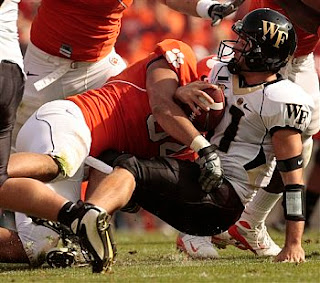
Aside from that whole surgery thing, Merling does have quite a lot going for him. He racked up 7 sacks and 17 TFLs as a junior, despite being the primary focus of opposing blocking schemes. He's a big guy, standing 6'4" and weighing in (pre surgery) at 276 pounds. He has a good burst as well, but he isn't so fast that he can just run past offensive tackles. He has enough moves, however, that he can get off of a block, and he routinely showed the ability to split the double team his junior year. He also plays the run well, is a solid tackler and was routinely praised for his backside pursuit, all of which he displayed while making 78 tackles last year.

The surgery wasn't the only question about Merling, however. Despite having Gaines Adams (4th overall pick in 2007) to draw the offense's focus, he only had 3 sacks his sophomore year. His 12 career sacks aren't as impressive when one considers that he played in the worst BCS conference. He also lacks the speed and quickness that a dominant pass rusher needs in the NFL, and he never displayed the strength necessary to compensate, leaving him as something of a tweener. Big linemen were able to swallow him up, and his burst, reactions and pass rush were significantly worse when he was set then when he was moving in a stunt or a twist.
With a good workout, in which he was able to address the questions about his speed, quickness and strength, Merling might have been able to justify his selection at #17. He wasn't able to work out, however, and is likely even further behind where a first round pick should be, in terms of conditioning, strength and ability to make an immediate impact. You only get one chance to make a first impression, and Merling missed his chance because of an injury. It would be a mistake for the Vikings' to draft him in the first round because they need a defensive end, when other talented players are available at other positions that the Vikings could use more talent at.
Many of the mock drafts, knowing the Vikings' need for a pass rusher, but thinking that Derrick Harvey will be drafted higher than #17, have guessed that the Vikings will draft Phillip Merling, a junior defensive end from Clemson. It makes a certain amount of sense-Merling is the only other defensive end seen as a mid first round pick aside from Harvey. Of course, like all things, it's slightly more complicated than that. As you may have heard, Merling hasn't yet worked out for anybody due to a sports hernia, an injury for which he just underwent surgery.

According to about.com, a sports hernia is "a weakening of the muscles or tendons of the lower abdominal wall". It's not a muscle injury, however. "The problem with the abdominal wall in people with a sports hernia is not a muscle strength issue. Rather, the abdominal wall in a particular region is too thin, allowing the hernia to form. The sports hernia does not occur in the area of the large, thick part of the muscle." It usually requires surgery, and it takes about 8 weeks to recover from the surgery. Which means that the Vikings, were they to draft Merling, would be drafting someone they had never seen workout in person, and someone coming off an injury that sidelined him for months. Not exactly the recipe for a successful draft pick.

Aside from that whole surgery thing, Merling does have quite a lot going for him. He racked up 7 sacks and 17 TFLs as a junior, despite being the primary focus of opposing blocking schemes. He's a big guy, standing 6'4" and weighing in (pre surgery) at 276 pounds. He has a good burst as well, but he isn't so fast that he can just run past offensive tackles. He has enough moves, however, that he can get off of a block, and he routinely showed the ability to split the double team his junior year. He also plays the run well, is a solid tackler and was routinely praised for his backside pursuit, all of which he displayed while making 78 tackles last year.

The surgery wasn't the only question about Merling, however. Despite having Gaines Adams (4th overall pick in 2007) to draw the offense's focus, he only had 3 sacks his sophomore year. His 12 career sacks aren't as impressive when one considers that he played in the worst BCS conference. He also lacks the speed and quickness that a dominant pass rusher needs in the NFL, and he never displayed the strength necessary to compensate, leaving him as something of a tweener. Big linemen were able to swallow him up, and his burst, reactions and pass rush were significantly worse when he was set then when he was moving in a stunt or a twist.
With a good workout, in which he was able to address the questions about his speed, quickness and strength, Merling might have been able to justify his selection at #17. He wasn't able to work out, however, and is likely even further behind where a first round pick should be, in terms of conditioning, strength and ability to make an immediate impact. You only get one chance to make a first impression, and Merling missed his chance because of an injury. It would be a mistake for the Vikings' to draft him in the first round because they need a defensive end, when other talented players are available at other positions that the Vikings could use more talent at.
Wednesday, March 26, 2008
Solving Our Problems: Malcom Kelly
[With Free Agency all but over, it's time to take a look at who the Vikings might select in the first round with the #17 pick. Today, we're previewing Chris Williams, an offensive tackle from Vanderbilt. Previously, I previewed Derrick Harvey, a defensive end from Florida and Chris Williams, an offensive tackle from Vanderbilt]
By signing Bernard Berrian, the Vikings seemed to have solved their problems at wide receiver, allowing them to focus on other positions with their first round pick. With the #17 pick, however, the Purple need to be willing to take the best player available. Focusing on need, rather than talent, leads to draft picks like Troy Williamson. Focusing on talent rather than need, leads to draft picks like Adrian Peterson. Enough said there.
Because of that, the Vikings need to be willing to draft a receiver in the first round if that receiver is the best player available. And there is a good possibility that Malcolm Kelly, a wide receiver out of Oklahoma, will be the best player available to the Vikings, something they seem to understand, as he is scheduled to visit Winter Park on April 10th. Kelly is a 6'3, 224 pound junior, with good speed, great hands and the ability be a big time play maker in the mold of Larry Fitzgerald.
Kelly had good but not great stats at Oklahoma, never breaking the 1000 yard mark, but averaging 55 catches for over 900 yards and more than 9 touchdowns his final two years. What was impressive was how he wrote his name all over the Oklahoma record books. He is the school's fifth-leading receiver with 144 catches, is second all time for receiving yardage (2,285), touchdown catches (21) and games with at least 100 yards receiving (nine). His 21 scoring receptions also rank tied for seventh in Big Twelve Conference history. His stats were impressive for their context, that of an offense that focused on the run (more than understandable, considering they had Adrian Peterson for the first two years he was there, and a freshman quarterback his final year.). Of course, that meant he learned how to block, something he is pretty good at. Kelly also showed why his hands are considered the best in the draft class, as he dropped only one pass in two years. In doing so, he also demonstrated superb body control by being able to adjust to almost any throw.
While he's not a speed demon, Kelly has more than enough speed to be a deep threat. His forty time is around 4.5 seconds, and he was used as the Sooners primary deep threat. So while he has the size and strength to fight off a jam at the line, the ability to go over the middle, and the soft hands you'd want in a possession receiver, he's not limited by his speed in the way Dwayne Jarret or Keyshawn Johnson were. He's also considered a superb route runner, who, despite have long strides, is able to get low into his breaks (rare for taller receivers) and explode out of them. And once gets the ball in the open field, he's going to be able to break a lot of tackles due to his size and strength.
Kelly appears to be the complete package, but there are some question marks. He 1asn't been able to work out at the combine because of a thigh injury, and he has had problems with minor injuries, causing him to miss the majority of three separate games his last two years. Kelly also had a tendency to go long stretches without impacting the game. Whether that was due to his own lack of focus or the Sooners focus on the run is up in the air.
With only a few minor question marks, and lots of talent and potential, Malcolm Kelly is the best receiver in the draft. If he is available to the Vikings with the 17th pick, and their top choice at defensive end and offensive tackle are gone, they should strongly consider drafting him, no matter what Brad Childress thinks about drafting receivers in the first round.
Also, Malcom Kelly can rap. And yes, this video does move him to the top of my draft board.
Tuesday, March 25, 2008
Solving Our Problems: Chris Williams
[With Free Agency all but over, it's time to take a look at who the Vikings might select in the first round with the #17 pick. Today, we're previewing Chris Williams, an offensive tackle from Vanderbilt. Previously, I previewed Derrick Harvey, a defensive end from Florida.]
One of the less talked about problems facing the Vikings this season is their offensive line, specifically the tackle and center positions. At left tackle, Bryant McKinnie is the on field stalwart, big, talented and willing to play hurt.Off the field, he’s just violated the NFL’s conduct policy for the second time and will almost certainly be forced to miss four or more games because of it. At right tackle, Ryan Cook has been inconsistent at best in his two seasons. He’s also the backup left tackle (a position he’ll likely play during McKinnie’s suspension) and the backup center, which was the position he was drafted to play and one that he may need to play, as Matt Birk, like all people, continues to age. If Birk were to be injured,(or pout and holdout) especially during McKinnie’s suspension, it would force Marcus Johnson and Chase Johnson (I don't know who he is either) into the lineup, and guarantee that Tarvaris Jackson would get to know the NFL North’s pass rushers intimately, the last thing you would want a young, inexperienced quarterback with a history of injury problems to do.
The Vikings chose not to pursue any linemen in free agency, which means that, unless they choose to trade McKinnie for another lineman (not likely), they are going to have to address their line issues via the draft, which I expect them to do. I would be surprised to see the Purple take less than two offensive linemen with their 9 picks, and I wouldn’t be surprised to see them take a replacement for McKinnie in the first round, allowing them to trade their trouble making left tackle. Today I’m going to take a look at Chris Williams, a senior All SEC left tackle from Vanderbilt.

Williams is a tall guy, measuring in at 6’6”, but he doesn’t have the bulk you’d expect from someone that tall, weighing in at “only” 317 pounds. That didn’t affect his ability to contain some of the best pass rushers in college football, however, as he allowed only two sacks in his last two years at Vanderbilt, one in the first game of his junior year and one in his senior year. He did so by using quick footwork, a tremendous reach and good body control to contain and control the pass rusher off the edge. He also has tremendous football instincts, quickly recognizing stunts and twists, and he communicates well with his guard.
His communication skills also show up as leadership abilities, as his coaches at Vanderbilt counted on him as a mentor to younger players and as the leader of the offensive line. He responded well 0to these extra responsibilities, and continued to put in extra work in the film room and practice to improve. He has the work ethic that you want out of your first round pick, and doesn’t need the continual monitoring that other players do.

Like all prospects, there are some question marks. While there are no doubts about his work ethic, there are doubts about his intensity and killer instinct. He wasn’t the mauler that you’d expect someone his size to be. He relied mainly on technique, rather than raw strength, to contain pass rushers. His run blocking isn’t great either, despite the fact that Vanderbilt liked to run behind him. He struggles with drive blocking because of his height, and doesn’t always get low enough. He isn’t as strong as you’d want him to be either, something that manifests in his run blocking and his use of finesse pass blocking techniques.
The big question with Williams is his intensity. He can and should get stronger in an NFL workout plan, which he can be counted on to follow through with. He has almost everything else you’d want in a left tackle. Whether that will translate into a dominant left tackle will depend a lot on whether he plays aggressively, supplementing his technique with strength and a willingness to attack the rusher, rather than let the rusher come to him. If he does that, he’d be a great addition to the Vikings line, and would allow the Purple to shop Bryant Mckinnie. If he can’t, he should still be good, but he won’t be the reliable pass blocker a good team needs at left tackle.
Monday, March 17, 2008
Solving Our Problems: Derrick Harvey
[Solving Our Problems is an ongoing series here at the Ragnarok where I evaluate the Vikings' options going into the offseason. I started by looking at the quarterback options, examining Derek Anderson, Donovan McNabb and possible backups for Tarvaris Jackson. I've tried to figure out who the QB is going to throw to, starting with free agents Bernard Berrian and Donte Stallworth, and taken a detour to look at a safety the Vikings might sign, Madieu Williams. While detouring, I figured that it might be worth it to look at another QB the Vikings might end up with, Sage Rosenfels. Now that free agency is all but over, it's time to look at some of the Vikings' draft options, starting with Derrick Harvey, a junior end from Florida.]
Derrick Harvey, a redshirt junior out of Florida, is perhaps the best defensive end that could be available to the Vikings (I've yet to see a mock draft where Chris Long or Vernon Gholston drops out of the top ten). He's almost 6'5, weighs about 271 lbs and is cat quick, something he demonstrated in his last two years at Florida, where he racked up 11 sacks and 13 tackles for a loss his sophomore year and 8.5 sacks and 17 tackles for a loss his junior year. His junior year production was enough to lead the Gators in both sacks and tackles, and both totals were fifth in the SEC, despite being the main focus of opposing teams pass protection schemes. He has a reputation as a good run stopper as well, as can be seen by how many tackles he made in the backfield.

Harvey isn't perfect, however. 271 is undersized for a defensive end (though not undersized for the Vikings, where he would be the third heaviest end, behind Keneci Udeze and Jayme Mitchell) and his 4.83 forty time isn't great. Neither his weight, nor his forty time are worth worrying about. While he was overpowered by larger tackles at times, he was still very productive despite facing tackles that weighed an average of 311 pounds. And he's shown that he can put on weight, as he entered college weighing only 235 pounds. Of course, if he adds too much weight, he'll lose the main reason for his success: his quickness. His forty time doesn't stick out, but that doesn't matter as much as his initial first step, something scouts are raving about.

Harvey has the quickness, the production and the upside that you want in your first round pick. He would also help address a position of need for the Purple, and could have an impact in his rookie year, just like another speed demon who left Florida early after winning a national title in his redshirt sophomore year.
[If you're looking for draft information, I recommend NFL Draft Countdown and NFL Draft Scout, both of which are also linked on the sidebar.]
Derrick Harvey, a redshirt junior out of Florida, is perhaps the best defensive end that could be available to the Vikings (I've yet to see a mock draft where Chris Long or Vernon Gholston drops out of the top ten). He's almost 6'5, weighs about 271 lbs and is cat quick, something he demonstrated in his last two years at Florida, where he racked up 11 sacks and 13 tackles for a loss his sophomore year and 8.5 sacks and 17 tackles for a loss his junior year. His junior year production was enough to lead the Gators in both sacks and tackles, and both totals were fifth in the SEC, despite being the main focus of opposing teams pass protection schemes. He has a reputation as a good run stopper as well, as can be seen by how many tackles he made in the backfield.

Harvey isn't perfect, however. 271 is undersized for a defensive end (though not undersized for the Vikings, where he would be the third heaviest end, behind Keneci Udeze and Jayme Mitchell) and his 4.83 forty time isn't great. Neither his weight, nor his forty time are worth worrying about. While he was overpowered by larger tackles at times, he was still very productive despite facing tackles that weighed an average of 311 pounds. And he's shown that he can put on weight, as he entered college weighing only 235 pounds. Of course, if he adds too much weight, he'll lose the main reason for his success: his quickness. His forty time doesn't stick out, but that doesn't matter as much as his initial first step, something scouts are raving about.

Harvey has the quickness, the production and the upside that you want in your first round pick. He would also help address a position of need for the Purple, and could have an impact in his rookie year, just like another speed demon who left Florida early after winning a national title in his redshirt sophomore year.
[If you're looking for draft information, I recommend NFL Draft Countdown and NFL Draft Scout, both of which are also linked on the sidebar.]
Thursday, February 28, 2008
Solving Our Problems: Sage Rosenfels
[Solving Our Problems is an ongoing series here at the Ragnarok where I evaluate the Vikings' options going into the offseason. I started by looking at the quarterback options, examining Derek Anderson, Donovan McNabb and possible backups for Tarvaris Jackson. I've tried to figure out who the QB is going to throw to, starting with free agents Bernard Berrian and Donte Stallworth, and taken a detour to look at a safety the Vikings might sign, Madieu Williams. While we're detouring, I figured that it might be worth it to look at another QB the Vikings might end up with, Sage Rosenfels.]
According to Don Banks of SI.com, the Vikings have offered Houston a third round pick for Sage Rosenfels, their backup quarterback. I hope Banks is telling the truth, because Rosenfels would be perfect as the Vikings backup QB. He's experienced, is happy as a backup and has shown over the last two years that he's good enough to step up and help the Purple win if he's needed, whether because Tarvaris got hurt (which happened all too often last year) or because Tarvaris is struggling (which also happened all too often).
Last year, Rosenfels started 4 games for the Texans due to injuries to Matt Schaub, and played in 5 others. In those 9 games, he completed 64% of his 246 passes for 1647 yards and 15 touchdowns, which was good for a 84.8 QB Rating. While he did throw 13 interceptions, he still amassed 39.3 DPAR, which was the 18th highest total in the NFL. He was also the 9th most valuable QB in the NFL on a per play basis, with a DVOA of 21.7%.
And those numbers weren't that much better than his statistics from 2006 either. He didn't get a lot of playing time In the 4 games he played in that year, but he was successful when he was on the field, completing 69% of his 39 for 268 yards and 3 touchdowns, while only throwing 1 pick. His advanced statistics weren't too shabby either, as he had a 9.6 DPAR and a 39.8% DVOA.
Another thing Rosenfels has going for himself is that he rarely gets sacked. He was only dropped once every 41 times he went back to pass, an astoundingly low rate. Rosenfels has only been sacked 10 times in his entire career and was sacked only once every 39.8 pass attempts. To put that in context, Tarvaris had about as many pass attempts (313), but was sacked 19 times last year, or once every 16.5 dropbacks, which isn't that bad of a sack rate (David Carr's sack rate is once every 9.4 drop backs).
Even if he cost the Vikings a third round pick, Rosenfels would be a much better backup than almost all of the other options that have been discussed. Trent Green and Steve McNair are old and injury prone, Cleo Lemon and Josh McCown have never demonstrated competence, and Chad Pennington, Quinn Gray and Chris Simms all want to be starters (not to mention Pennington and Simms injury issues). A third round pick has value (the last three years, Vikings drafted Marcus McCauley and Dustin Fox in the third round, and used their pick in 2006 to move up in the second round) but not as much as value as having a legitimate backup for an inexperienced starter at the most important position on the field. The Vikings made that mistake last year and it cost them a playoff spot. If they are able to acquire Rosenfels, it'll show that Childress has learned from his mistake, which would be a very good sign. It would also mean that they are set at the quarterback position going into the season, something they haven't been able to say since before the 2005 season.
According to Don Banks of SI.com, the Vikings have offered Houston a third round pick for Sage Rosenfels, their backup quarterback. I hope Banks is telling the truth, because Rosenfels would be perfect as the Vikings backup QB. He's experienced, is happy as a backup and has shown over the last two years that he's good enough to step up and help the Purple win if he's needed, whether because Tarvaris got hurt (which happened all too often last year) or because Tarvaris is struggling (which also happened all too often).
Last year, Rosenfels started 4 games for the Texans due to injuries to Matt Schaub, and played in 5 others. In those 9 games, he completed 64% of his 246 passes for 1647 yards and 15 touchdowns, which was good for a 84.8 QB Rating. While he did throw 13 interceptions, he still amassed 39.3 DPAR, which was the 18th highest total in the NFL. He was also the 9th most valuable QB in the NFL on a per play basis, with a DVOA of 21.7%.
And those numbers weren't that much better than his statistics from 2006 either. He didn't get a lot of playing time In the 4 games he played in that year, but he was successful when he was on the field, completing 69% of his 39 for 268 yards and 3 touchdowns, while only throwing 1 pick. His advanced statistics weren't too shabby either, as he had a 9.6 DPAR and a 39.8% DVOA.
Another thing Rosenfels has going for himself is that he rarely gets sacked. He was only dropped once every 41 times he went back to pass, an astoundingly low rate. Rosenfels has only been sacked 10 times in his entire career and was sacked only once every 39.8 pass attempts. To put that in context, Tarvaris had about as many pass attempts (313), but was sacked 19 times last year, or once every 16.5 dropbacks, which isn't that bad of a sack rate (David Carr's sack rate is once every 9.4 drop backs).
Even if he cost the Vikings a third round pick, Rosenfels would be a much better backup than almost all of the other options that have been discussed. Trent Green and Steve McNair are old and injury prone, Cleo Lemon and Josh McCown have never demonstrated competence, and Chad Pennington, Quinn Gray and Chris Simms all want to be starters (not to mention Pennington and Simms injury issues). A third round pick has value (the last three years, Vikings drafted Marcus McCauley and Dustin Fox in the third round, and used their pick in 2006 to move up in the second round) but not as much as value as having a legitimate backup for an inexperienced starter at the most important position on the field. The Vikings made that mistake last year and it cost them a playoff spot. If they are able to acquire Rosenfels, it'll show that Childress has learned from his mistake, which would be a very good sign. It would also mean that they are set at the quarterback position going into the season, something they haven't been able to say since before the 2005 season.
Solving Our Problems: Madieu Williams
[Solving Our Problems is an ongoing series here at the Ragnarok where I evaluate the Vikings' options going into the offseason. I started by looking at the quarterback options, examining Derek Anderson, Donovan McNabb and possible backups for Tarvaris Jackson. I've tried to figure out who the QB is going to throw to, starting with free agent Bernard Berrian and Donte Stallworth, but I'm going to take a detour and take a look at a safety the Vikings might sign, Madieu Williams]
The Star Tribune had an article today about the Vikings' possible targets in free agency, and it's a positive one, because the Vikings are going to go after top talent. According to the article, the Vikings top three targets are wide receiver Bernard Berrian, defensive end Justin Smith and safety Madieu Williams. I covered why the Vikings should try and sign Berrian earlier, and Grant's Tomb took a look at the possibilities in the free agent market at defensive end, which I agree with, because I don't think the Vikings are going to spend big money on a pass rusher, because the talent isn't there. Aside from Smith, who struggled in his free agency year, there really aren't any game changing talents. That, combined with the fact that the draft has some quality talent at the position, makes me think that the Purple will spend their $30 million to fill other gaps, mainly wide receiver and safety. And, with Dwight Smith signing with the Lions, the Purple have to find a player to pair with Darren Sharper, and Madieu Williams is their top target.
Williams has spent his four years playing for the Bengals, but you shouldn't let that scare you. He's a talented safety, and is known off the field for his charity work (you thought I was going to say "legal troubles", didn't you? Well, he's not that kind of Bengal). And unlike Smith, his talents lie in coverage, not run support. As Football Prospectus 2007 put it, "Williams in particular is excellent in coverage and can help cover the deficiencies of the corners."
The information in the following table was taken from Football Prospectus 2007, so the stats are from 2006. I don't have access to the stats from last season yet. However, based on what I've read about Williams, he played about as well in 2007 as he did in 2006. And based on watching Smith, I think he preformed about as well this year as he did last year. So I believe that the information below is still relevant in comparing the two.
The first two statistics deal with the safeties ability to stop the run. RuYd shows where the player normally tackled a runner past the line of scrimmage and RuStp deals with the percentage of run plays in which the player was involved in stopping. The second two statistics deal with stopping the pass. Suc% is the percentage of plays targeting a player on which the offense did not have a successful play. "This means not only incomplete passes and interceptions but also short completions that do not meet our baselines for success (45 percent of needed yards on 1st down, 60 percent on 2nd down, 100 percent on 3rd or 4th down)". PD is passes defensed, which is a counting stat that includes any time a player knocked down a pass or intercepted it. Where the player ranks out of all NFL defensive backs in the first three statistics is also included.
| | RuYd | Rank | RuStp | Rank | Suc% | Rank | PD |
| Madieu Williams | 8 | 62nd | 43% | 39th | 69% | 3rd | 10 |
| Dwight Smith | 4.6 | 10th | 55% | 13th | 43% | 64th | 7 |
As you can see, Williams is nowhere near the run stopper that Smith is and Smith is nowhere near as good at coverage as Williams is, except when he comes to intercepting passes, as Smith has averaged 3.25 picks over the last four years, while Williams has averaged only 2.25 picks over the same time period. One extra interception a year isn't that big a loss, however, when you consider that Williams was almost 25% more successful at stopping plays targeting him.
While replacing Smith with Williams would likely hurt the Vikings' run defense, adding a safety with Williams' coverage ability would be a huge gain for the Vikings' pass defense. Williams and Sharper (his Suc% was also 69%) would likely make up the best pair of coverage safeties in the NFL, which would more than offset whatever damage it would do to the Vikings' run defense. And, the Vikings' can afford losing some of their ability at stopping the run if it means improving their mediocre pass defense, especially at a position that isn't as vital to run defense. Signing Williams would accomplish that, and in today's NFL, being able to stop the pass is of vital importance.
Tuesday, February 26, 2008
Solving our Problems: Donte Stallworth
[Solving Our Problems is an ongoing series here at the Ragnarok where I evaluate the Vikings' options going into the offseason. I started by looking at the quarterback options, examining Derek Anderson, Donovan McNabb and possible backups for Tarvaris Jackson. Now it's time to figure out who the QB is going to throw to, starting with free agent Bernard Berrian and now Donte Stallworth.]
One of the best things that Donte Stallworth has going for him is that he is available on the free agent market. The Patriots have already declined his option. The actual best thing? The fact that he has an alter ego , named Nicco that punishes him when he messes up on the field and lives on Mars when he's not playing.
Now, even if he didn't have an alter ego from Mars, (which, honestly, is more than enough to convince me that the Vikings should sign him), the Vikings should still pursue Stallworth this offseason. Stallworth would be a perfect complement for the Vikings current wide receivers, adding a deep threat that the Vikings are currently lacking (since Sidney Rice is not quite ready yet). Over the last three years, he's averaged 15 catches over 20 yards, and almost three catches over 40 yards a game. To put that in context, Robert Ferguson lead the Vikings in catches over 20 yards, with 5, and no receiver on the Vikings roster has ever had a season with more than 8 receptions for over 20 yards. His yards and touchdowns last year were their lowest in four years, but I think it's safe to say that was mostly due to the fact that he was Tom Brady's third option, behind Randy Moss and Wes Welker. The fact that he's only 27, and that his 46 receptions and 15.2 yards per catch were both the third highest of his career also support that assertion. And not only did he not experience any drop off in DPAR or DVOA, he posted his highest total since his rookie year, with a 15.9 DPAR and a 16.2% DVOA.
One has to wonder how much of that value actually should be attributed to the offense he was playing in and the fact that he was able to play in all 16 games, something he has only able to do two other times in his six year career. His catch percentage in 2007 seems to support the theory that Tom Brady had a lot to do with his high value, as he caught 62% of the passes thrown his way, a career high. The only other time his catch percentage broke 60% was in his rookie year, and he's had two seasons where he caught less than 50% of the passes thrown his way.
It's his catch percentages, combined with his history of injury problems that have prevented him from taking the step from "deep threat" to "#1 receiver". Stallworth's career high in receptions is 70, in 2004, and it's the only time he's had more than 58 in a season. He's never averaged more than 60 yards receiving per game, or had 1000 yards receiving in a season. His career high is 945 yards, in 2004, and it's the only season he's had more than 800 yards receiving. Also, the closest he's come to double digit touchdowns was in his rookie year, when he had 8 TDs.
It's for those reasons that Stallworth would not be the best receiver the Vikings could sign. Bernard Berrian is. However, if the Purple can't sign Berrian, Stallworth would still be a good acquisition, adding a deep threat and a veteran presence that the Purple would be lacking. And finally, he'd be a 2-1 deal, which is the kind of bargain you can't get just anywhere.
Subscribe to:
Posts (Atom)
